Why I stopped driving to the view, and started earning it.
Most people who paint Cornwall arrive by car. They park as close as the National Trust will let them, walk the last few hundred yards, set up, and paint the postcard everyone else painted from the same spot.
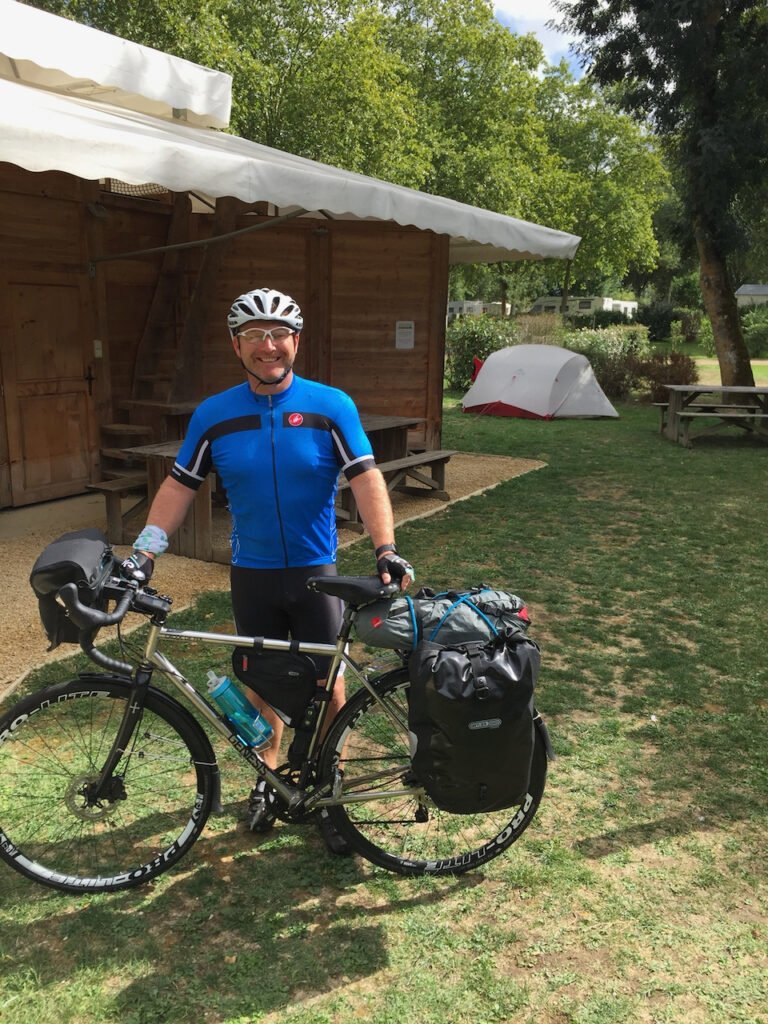
I cycle to mine.
It started as a practical thing and turned into the whole point. I’d been looking for a way to paint more — properly more, not “I’ll get to it at the weekend” more — and I kept hitting the same wall. The drive. The faff. The day that gets eaten before it’s started. And meanwhile I had a bike, two acres of Cornwall on the doorstep, and a body that has spent its whole life happier when it’s moving.
So one morning I just strapped a small painting kit to the bike and rode out to a spot I’d always meant to paint. By the time I got there I’d already half-composed the picture in my head. I was warm, I was awake, and — this is the part I didn’t expect — I’d seen the place properly on the way in, instead of arriving at it cold from a car park.
That’s the Cornish Cycling Sketcher. Ride to the spot. Paint the spot. Ride home. It’s not a gimmick and it’s not a fitness regime dressed up as art. It’s the most honest way I’ve found to make work outdoors.
Why the bike changes the painting
Here’s the thing nobody tells you about plein air: most of the painting happens before you lift the brush.
When you drive somewhere, you arrive as a tourist. You step out of a metal box, slightly stiff, slightly distracted, and you point yourself at the obvious view because you haven’t earned any other one. The light is whatever it is. You set up where the car is.
When you cycle, you arrive having already travelled through the landscape. You’ve felt the gradient of the land in your legs. You’ve watched the light change for the last forty minutes. You’ve passed three better compositions than the famous one and clocked them. By the time you stop, you already know what you want to paint and roughly how — because you’ve been looking the entire way.
The body warms the eye up. I don’t have a more scientific way to say it than that. Movement before making is something I bang on about a lot — it’s baked into how I teach — and the bike is the cleanest version of it I know. You can’t half-do a bike ride. You commit, the same way you have to commit to a wet wash. By the time you’re off the saddle, the dithering is gone.
The friction is the feature
The bike also imposes a discipline that I’ve come to love: you can only carry what fits.
A car lets you bring everything — the big easel, the full palette, the spare boards, the chair, the flask, the what if I need it. And everything you bring is a small permission to procrastinate. More choices, more setup, more reasons to fuss instead of paint.
A bike says no. A bike says: one small box, a pad, a brush or two, water, done. (I’ve written a whole separate piece on exactly what fits and how I pack it — that’s its own rabbit hole.) The constraint forces the thing every painter struggles with, which is simplification. Fewer colours. Fewer marks. Decide before you go.
It turns out the limit you resent at the door is the gift you thank at the spot.
You don’t need Cornwall, and you don’t need to be fit
People assume this is only available to me because I happen to live ten minutes from cliffs the rest of the world saves up for. Fair. The scenery here is absurd and I’m not going to pretend otherwise.
But the principle travels. The whole idea is movement plus making — get to your subject under your own steam, arrive with your eye already switched on, and carry so little that you’re forced to keep the painting simple. That works from a town. It works on a canal towpath. It works riding to the same park bench every week until you know its light by heart.
And you don’t need to be an athlete. I’ve trained for triathlons and I’ve also wrestled with weight and energy like everyone does — the bike doesn’t care which version of me turns up. A gentle twenty minutes to a spot you can sit at is enough. The point isn’t the ride. The point is arriving ready.
How to start this week
- Pick one paintable spot you could reach by bike in under half an hour. Not the best one. The easiest one.
- Pack the smallest kit you can bear. A pad, a tiny box of paint, one or two brushes, a water pot, a rag. If it doesn’t fit in a small bag, leave it.
- Go in the morning if you can. The light’s kinder and the world’s quieter.
- Give yourself permission to come home with something terrible. The first few will be terrible. That’s the toll you pay, not a sign you’ve failed.
- Do it again next week to the same spot. The magic is in the return, not the novelty.
This is the first in an ongoing series — the Cornish Cycling Sketcher. I’ll be posting the kit that fits on the bike, the locations worth the ride, and the paintings that come back (good and bad). If you want to follow along, that’s what the subscribe button is for.